


Most conversations about cover lifters happen on the sales floor. A customer asks what it does, the salesperson explains how it simplifies daily spa use, and the decision often comes down to appearance and movement.
What gets far less attention is what happens after the sale.
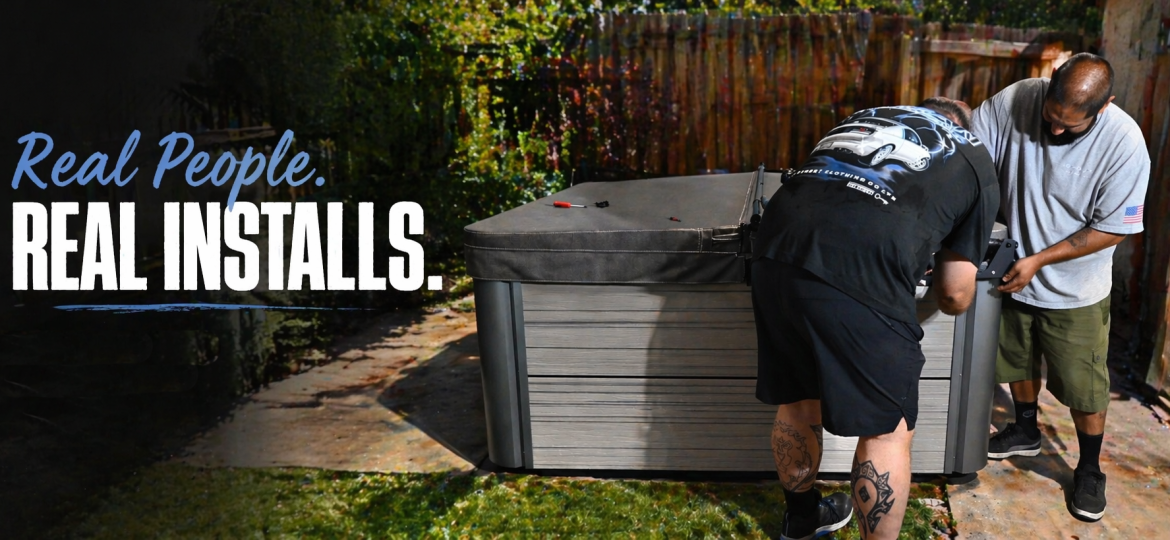
The install day is where a cover lifter is truly evaluated. The installer arrives with the product, the tools, and the expectation that everything will fit as planned. When it does, the process feels seamless. When it does not, it becomes a frustrating experience for everyone involved.
Understanding what makes an installation smooth versus complicated comes down to a few key factors. These are the details that matter not just for installers, but for homeowners and sales teams trying to get it right the first time.
1. The install starts before the install
The easiest lifters to install are the ones where the right model was matched to the spa before the truck left the warehouse.
That sounds obvious, but it is the single most common reason installs go sideways. A lifter shows up for a spa it was never designed for like wrong clearance, wrong cover shape, wrong spa material, wrong mounting surface and the install team is suddenly problem-solving on the customer’s patio.
The fix is not a better lifter. It is better information at the point of sale.
What to look for: A brand that gives you a clear, written match between customer scenario and product, not just a product catalog. If your sales team has to interpret specs to figure out which lifter fits which spa, the install team will be the ones paying for it later.
2. Clearance specs that are actually honest
Clearance is one of the most important and most misunderstood parts of choosing a cover lifter.
Every lifter needs space behind and beside the spa to open properly. If that space is not available, the lifter may not function at all, or it may cause damage over time.
What makes this tricky is that clearance is not always communicated clearly.
What clearance actually means
| Type of Clearance | Why it matters |
|---|---|
| Rear clearance | Space needed behind the spa for the cover to fold and rest |
| Side clearance | Space needed on the sides for arms or brackets to operate |
Real-world example
| Model | Rear Clearance | Side Clearance | Best For |
|---|---|---|---|
| Cover Valet PRO / Valet | 6–8 inches | 2.5 inches | Tight spaces, most standard installs |
| Cover EX | 12–15 inches | 4 inches | When a slightly higher lift arc is needed |
| Cover Rock-It | 18 inches | 3.5 inches | Undermount, simple setups |
| Cover RX | 18 inches | None | Clean look, no side obstruction |
| Cover Caddy | 36 inches | None | Large spaces, full lift and drop |
For a homeowner, the takeaway is simple. Measure your space before choosing a lifter.
For a retailer, the expectation should be even higher. Clearance should be clearly defined, consistent, and easy to explain without interpretation.
3. The cabinet question most people do not think about
One of the most common install challenges comes down to something customers rarely see.
What is behind the cabinet panel?
Mounted lifters rely on secure anchoring. That means the screws need to go into something solid. Not all spa cabinets are built the same way, and not all of them provide structural backing where it is needed.
What installers are looking for
- Solid wood or reinforced framing behind the cabinet panel
- Enough depth to support lag screws
- Proper spacing for bracket placement
When additional steps are needed
- Adding backing wood inside the cabinet
- Accessing the interior of the spa before mounting
- Adjusting bracket positioning based on cabinet construction
For homeowners, this is why some installs take longer than expected. It is not the product, it is what is behind the surface.
For retailers and installers, clear documentation around this step removes guesswork and reduces risk.
4. When you should not drill into the spa
There are situations where a mounted lifter is simply not the right choice.
Some spas are not designed to be drilled into. Others are installed in a way where drilling would compromise the look or integrity of the cabinet.
This is where undermount lifters come in.
Best candidates for undermount lifters
- Rotomolded spas
- Soft sided spas
- Cold plunge tubs
- High-end installations where appearance matters
- Tight spaces where side mounting is not possible
Surface requirements
Undermount systems rely on the weight of the spa, so the surface matters.
Suitable surfaces:
- Concrete
- Pavers
- Decking
Not suitable:
- Dirt
- Gravel
- Uneven ground
For homeowners, this often comes down to preserving the look of the spa.
For installers, it provides a cleaner, more adaptable solution when traditional mounting is not ideal.
5. Planning for the exceptions
Not every spa installation is standard, and over time, these “exceptions” become common.
Some of the most frequent scenarios include:
Common edge cases
- Large radius corners
Standard brackets may not sit correctly on curved cabinets (We have a bracket for that!) - Swim spas
Taller height requires lifters designed to handle the added reach - Inground spas
Undermount lifters are not an option - Cold plunge tubs
Smaller footprint, often tighter spaces
The difference between a smooth install and a failed one often comes down to whether these situations were considered ahead of time. A strong product lineup does not just handle the standard install. It provides clear solutions for these less predictable scenarios.
The quiet test of a good cover lifter
There is a simple question worth asking when evaluating any cover lifter.
When something goes wrong during an install, where does the responsibility fall?
If the answer consistently points to the installer or the environment, it may be a sign that not enough guidance was provided from the start.
The most reliable cover lifters are not defined by price or popularity. They are defined by how well they account for real-world conditions.
- Clear and honest specifications
- Realistic clearance requirements
- Guidance on cabinet structure
- Options for different spa types
- Solutions for edge cases
When those elements are in place, installation becomes consistent, efficient, and far less stressful.
And in most cases, the easiest install is not about what happens on site. It is about everything that was decided before it.