


For most of our industry, growth naturally starts with the question of how to find the next hot tub buyer. We invest in advertising, websites, search, social media, lead generation, events and showrooms, all with the goal of getting a new customer through the door.
There is another group of customers worth thinking about, though, and dealers have already spent the time and money acquiring them.
They are the people who bought a hot tub three, five, eight or even ten years ago. They already understand the benefits of hot tub ownership. They have already made space for one in their backyard. They know what they like about it, what they wish were easier and what they might do differently if they were making the purchase today. More importantly, many of them already know and trust the dealer who sold it to them.
That raises an interesting question for our industry. How much attention are we giving to the customers we already have?
The Years Between Two Spa Sales
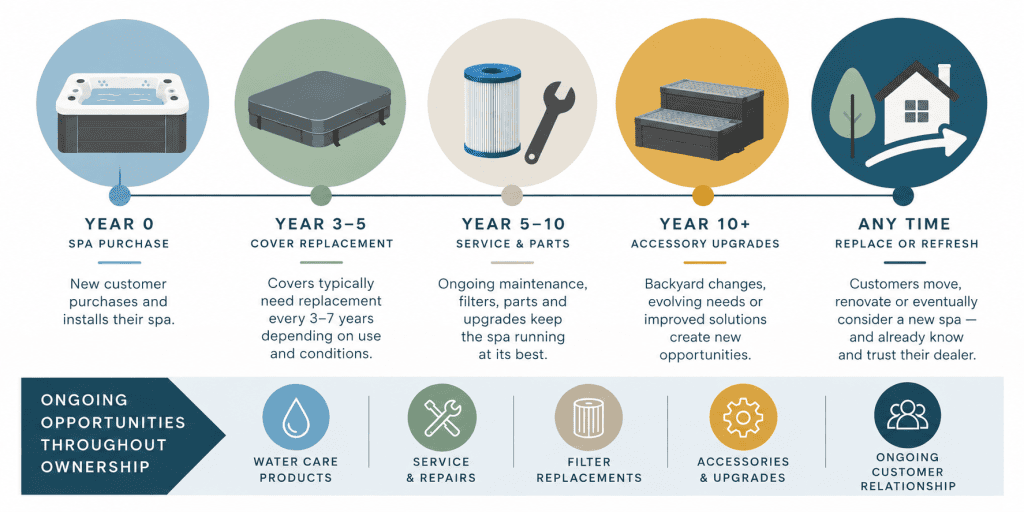
A hot tub can have a long life. Depending on the quality of the spa, its environment and how well it is maintained, some of its major components can remain in use for many years. The products around the spa have their own replacement cycles. Covers wear out. Steps age. Components need service. Backyards change and, just as importantly, customers change.
That creates a long period between the original spa purchase and the day that customer eventually considers replacing it.
From the dealer’s perspective, those years can either become a quiet period in the relationship or an ongoing series of opportunities to stay connected.
SpaRetailer recently explored this exact issue in an article about making better use of existing customer lists. The point was straightforward. Many dealers already have a significant marketing asset sitting in their CRM in the form of people who have purchased from them before. Those customers can represent future service, repairs, accessories and upgrades without the same challenge of first convincing them to trust the business.
It seems obvious when you put it that way, but it is easy to see why the industry tends to focus elsewhere. A new spa sale is highly visible. A replacement cover, new lifter or accessory upgrade is much smaller on an individual invoice. Across hundreds or thousands of existing customers, however, those smaller interactions become something much more significant.
They also keep the relationship alive.
A Customer Who Already Owns a Spa Is a Different Customer
Marketing to an existing hot tub owner should not look exactly like marketing to someone who has never owned one.
The first time buyer still needs to understand the category. They may be comparing a hot tub with another large discretionary purchase or wondering whether they’ll use it enough to justify the investment.
An existing owner has already crossed that bridge.
Instead of asking whether a hot tub belongs in their life, they are more likely to have practical questions based on experience. Their cover may have become heavier. Their original steps may no longer work with a renovated deck. They may want a better way to manage the cover when using the spa alone. Their physical needs may have changed. They may have moved the spa, redesigned the backyard or simply realized there are products available today that they didn’t know about when they originally bought it.
That gives dealers an entirely different starting point.
The conversation does not have to be about selling them on hot tub ownership again. It can be about helping them get more out of something they already own.
Ownership Changes the Conversation
There is an interesting behavioral economics concept that fits into this discussion called the endowment effect.
The concept became well known through research by Daniel Kahneman, Jack Knetsch and Richard Thaler. In simple terms, their experiments found that people can value an object differently once they own it. The research became an important part of the broader discussion around ownership, loss aversion and how people make economic decisions.
There has been plenty of academic discussion since then about when the effect appears and how strong it really is, so it would be an oversimplification to say that owning something automatically makes everyone value it more.
What is useful for our industry is the larger idea behind it. Ownership changes the frame of reference. Before buying a hot tub, someone is deciding whether they want to become a hot tub owner. After buying one, their questions become about the hot tub they already have.
How do I keep it running well? How can I make it easier to use? Is there a better way to handle the cover? Can I upgrade something without replacing the entire spa? What should I replace first? Is there something available now that wasn’t available when I bought mine?
Those are very different conversations, and dealers are particularly well positioned to answer them.
There Is a Replacement Cycle Happening Whether We Participate in It or Not
One of the more interesting things about the hot tub business is that not everything around the spa ages at the same rate.
A well maintained spa can remain in service for many years, while products around it may need replacement much sooner. Jacuzzi, for example, estimates that hot tub covers generally last somewhere around three to seven years depending on conditions and care, while major structural components of a quality spa can last considerably longer.
That means a customer who isn’t remotely ready for another spa may still have several purchasing moments during the life of the one they own.
The question is where those purchases happen?
When a cover needs replacing, does the customer call the dealership or start searching online?
When a lifter no longer suits their needs, do they know there are other options?
When they renovate the backyard, does anyone ask whether their current spa setup still works for the new space?
When getting in and out starts feeling different than it did eight years ago, do they know that steps or a handrail can change that experience?
If the dealer isn’t part of those conversations, someone else probably will be.
The CRM May Know More Than We Think
This is where good customer data becomes extremely valuable.
Imagine being able to look at your customer base not simply as one list of past purchasers, but according to where each customer might be in the ownership cycle. Someone who bought a spa last year needs different information from someone who purchased seven years ago. A newer owner might benefit from education about maintenance, water care and products that complement their original setup. Someone several years into ownership may be approaching a natural replacement window for a cover or other components. A much older customer may be thinking about larger upgrades or eventually replacing the spa itself.
None of this requires bombarding customers with promotions.
In fact, the more useful approach may be the opposite. Communication becomes more relevant because it is based on where the customer actually is. A message asking a seven year spa owner how their cover is holding up feels very different from sending the entire database another generic sale announcement. That is one reason clean, segmented customer data is becoming increasingly important. As marketing tools become more sophisticated, particularly with the growing use of automation and AI, the quality of the information behind them matters just as much as the technology itself.
Service Can Be Marketing Too
We sometimes separate marketing, sales and service as though the customer experiences them as different departments.
They don’t.
To the customer, every interaction is simply part of their relationship with the dealership.
A service appointment is an opportunity to notice that a cover is becoming waterlogged. A water care visit can lead to a conversation about something the customer has been struggling with. A replacement purchase brings the customer back into the store. A helpful email reminds them who to call when something eventually does need attention.
SpaRetailer has previously highlighted dealers using aftermarket products and ongoing customer programs as a way of maintaining relationships with owners after the initial sale. The lesson isn’t necessarily that every dealership needs a complicated loyalty program. It is that repeat contact has value beyond the transaction happening that day.
A customer who continues coming back for chemicals, service, filters, covers or accessories is still connected to the business.
Years later, when the conversation finally becomes, “Maybe it’s time for a new hot tub,” that relationship doesn’t have to start from zero.
What Has Changed Since They Bought Their Spa?
There is another opportunity with long term owners that is easy to overlook. The industry has continued developing products while they have been busy owning their hot tub. Someone who purchased eight years ago may have no idea what accessory options are available today.
They may still assume a cover lifter has to work exactly like the one they saw when they originally bought their spa. They may not know there are solutions designed for limited clearance or taller applications. They may never have considered adding a handrail because it wasn’t important to them at the time of purchase.
The customer has changed too.
Maybe the person who used to remove the cover with their spouse now uses the spa alone more often. Maybe their kids have moved out. Maybe they’ve become grandparents. Maybe they renovated the deck or moved homes and brought the spa with them.
Products shouldn’t only be matched to the spa. They should also be matched to the way the owner uses it today. That gives dealers a very natural reason to reconnect without needing to manufacture urgency.
The Cover Valet Opportunity
For Cover Valet dealers, there is an obvious application.
Our products are often discussed during a new spa purchase, and they absolutely belong in that conversation. But a new spa sale isn’t the only time someone may need a cover lifter, steps, a handrail or another accessory.
There is an entire installed base of hot tubs already sitting in backyards. Some have no cover lifter at all and others have one that no longer works for the customer’s situation. Some owners may have inherited the spa when they bought their home. Others may have purchased their spa somewhere else but now need a local dealer they can rely on.
Those customers are part of the market too.
Instead of asking only how many new spas will be sold this year, there may be another useful question to ask.
How many spas are already in our market, and what do those owners need now?
The Customer List Is More Than a List
There is a tendency in marketing to constantly look outward. More impressions, more traffic, more leads and more people entering the top of the funnel. Those things are important, and every business needs new customers. But growth doesn’t always have to begin with someone who has never heard of you. Sometimes it begins with the customer whose name has been in the CRM for six years. They already own the product, already understand the lifestyle and they may already trust the dealership. The opportunity is simply to give them a reason to come back.
For dealers, that could mean taking a fresh look at the customer database and asking a few different questions. How many customers bought a spa more than five years ago? When did we last communicate with them? What products are likely to need attention at this point in ownership? Are we educating existing customers about newer solutions, or are we only showing those products to people currently buying a spa?
There may be more opportunity in those answers than we realize.
Your next customer may not be shopping for their first hot tub.
They may already have one sitting in the backyard.
Milf In Fishnet Stocking And High Heels Have Sex On Bed
Blonde MILF Gets Deeply Satisfied By A Strong Lover – Big Tits & Intense Orgasm | Virtual Sex Generated]
Jerking Your Fat Cock With My Oiled Feet